



| MCT type | Properties and notes |
|---|---|
| C6 (caproic acid) | The shortest MCT. Rapidly metabolised but has a strong, unpleasant taste and can cause gastric discomfort. Rarely used in supplements. |
| C8 (caprylic acid) | Generally the most ketone-producing of the common MCTs. Rapidly absorbed and converted into ketones — the primary MCT source in ButterFat Keto. |
| C10 (capric acid) | Also ketogenic, though more slowly than C8. Often blended with C8 in mixed MCT oils. |
| C12 (lauric acid) | The longest MCT and the main fatty acid in coconut oil. Behaves more like a long-chain fat, with a lower ketogenic effect than C8 or C10. |
The ketogenic diet and intermittent fasting have moved from fringe nutrition strategies to mainstream wellness tools, supported by growing research into their effects on energy metabolism, weight management, cognitive function and metabolic health. At the heart of both is a simple principle: when carbohydrate intake is significantly reduced, the body increasingly relies on stored fat as fuel, producing ketones that many tissues — including the brain and muscles — can use as an alternative energy source.
Medium-chain triglycerides (MCTs), particularly caprylic acid (C8), are widely used in ketogenic nutrition because they are absorbed and metabolised differently from most dietary fats. Rather than undergoing extensive digestion and lymphatic transport, MCTs are absorbed primarily via the portal circulation and readily converted by the liver into ketones.
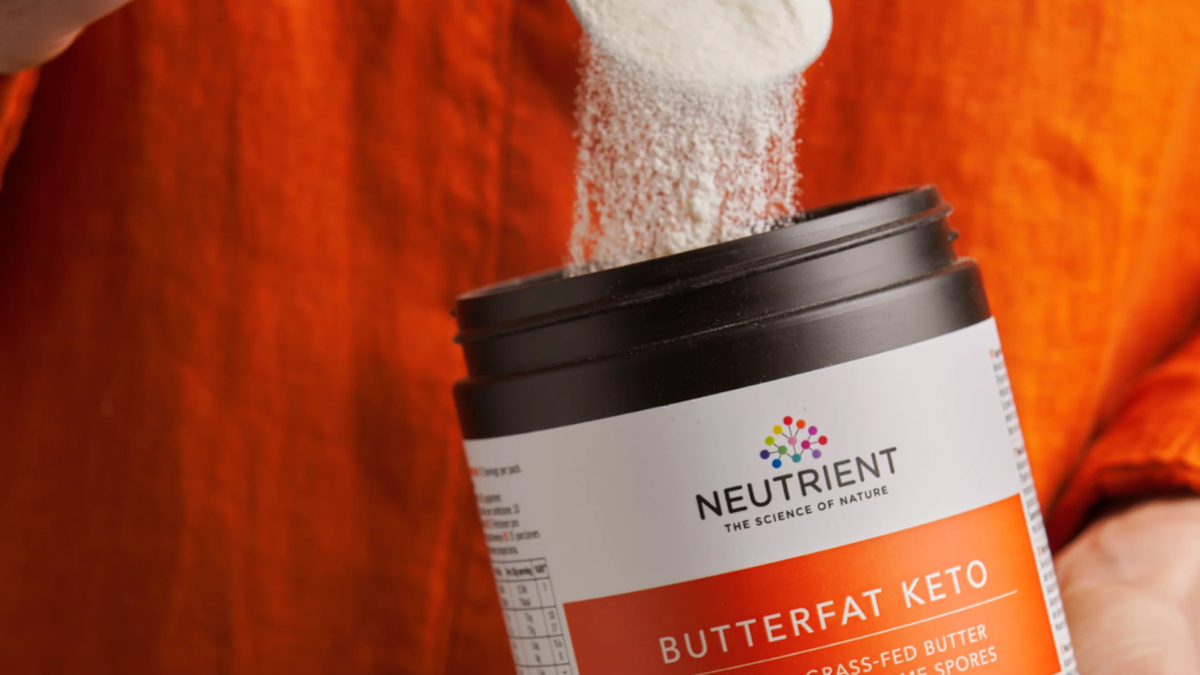
Neutrient ButterFat Keto is built around this mechanism. It is a keto coffee creamer in powder form that combines 4g of pure C8 MCT oil per serving with organic ghee, grass-fed butter, prebiotic fibre from acacia gum and resistant maltodextrin, and 300 million CFU of heat-stable microbiome spores. It dissolves easily into any hot or cold drink, turning a morning coffee into a nourishing, appetite-satisfying start to the day.

What are medium-chain triglycerides?
Triglycerides are the primary form in which fats are stored and transported in the body — a glycerol molecule attached to three fatty acids, whose chain length influences how they are digested and metabolised. Most dietary fats are long-chain triglycerides, which need bile acids for digestion and travel through the lymphatic system. Medium-chain triglycerides (MCTs) have shorter fatty-acid chains (6 to 12 carbons), so they are absorbed more rapidly and transported primarily via the portal vein to the liver, where they can be readily used for energy and ketone production.
When C8 MCT reaches the liver it undergoes beta-oxidation and can be converted into ketone bodies including beta-hydroxybutyrate (BHB). These ketones circulate and can be used as fuel by the brain, muscles and heart, readily crossing the blood-brain barrier. Because C8 is converted into ketones relatively efficiently compared with other MCTs, it is popular with people following ketogenic approaches.
The four MCTs — and why C8 is different
ButterFat Keto uses MCT oil standardised to 40% C8 caprylic acid, so each serving delivers a concentrated, consistent source of this ketogenic fatty acid. To obtain 4g of pure C8 from whole coconut oil alone you would need around 40–50g of coconut oil and over 400 calories; ButterFat Keto delivers the same 4g of standardised C8 in a 10g, 75-calorie serving.
Natural dietary sources of MCTs
ButterFat Keto provides a concentrated source of C8, but MCTs also occur naturally in several foods, where the amount and composition vary considerably depending on the source.
| Food source | MCT content and notes |
|---|---|
| Coconut oil | ~50–60% MCTs, of which around 7–10% is C8. A rich whole-food source but dominated by C12 lauric acid. |
| Palm kernel oil | A fatty-acid profile broadly similar to coconut oil; provides a mixture of medium-chain fatty acids. |
| Grass-fed butter | ~8–12% MCTs, providing C8, C10 and C12 alongside long-chain fats and fat-soluble vitamins. |
| Ghee (clarified butter) | A similar profile to butter but more concentrated, as water and milk solids are removed. |
| Full-fat dairy (milk, cheese) | 2–10% MCTs, varying with the fat content of the product. |

Natural food sources of MCTs and healthy fats
A well-formulated ketogenic diet draws on a range of natural fat sources, and ButterFat Keto is designed to complement rather than replace these foundations.
| Food | Relevant fat and notes |
|---|---|
| Coconut oil | Saturated fat containing lauric acid and some medium-chain fatty acids; commonly used in cooking. |
| Ghee | Clarified butterfat providing fat-soluble nutrients and small amounts of short- and medium-chain fatty acids. |
| Grass-fed butter | May contain higher levels of CLA and omega-3s than conventional butter, depending on feed and season. |
| Avocado | Rich in monounsaturated fat and a source of potassium; a useful low-carb food. |
| Oily fish (salmon, mackerel, sardines) | Rich in EPA and DHA omega-3 fats that support normal heart and brain function. |
| Eggs (whole, pastured) | Nutrient-dense, providing complete protein, choline and fat-soluble nutrients. |
| Extra-virgin olive oil | High in monounsaturated fat and polyphenols; ideal for low-heat cooking and dressings. |
| Hard and soft cheeses | Moderate MCTs, CLA, protein and fat-soluble vitamins; full-fat varieties suit a ketogenic diet. |
What is C8 MCT good for?
C8 MCT is metabolised differently from most dietary fats, which is why it has attracted interest across ketogenic nutrition, exercise metabolism and cognitive performance. The sections below cover the areas where C8 MCT has been most studied.


The ketogenic diet and fasting: how ButterFat Keto fits
A ketogenic diet substantially reduces carbohydrate intake while increasing the proportion of calories from fat. When carbohydrate is sufficiently restricted, the body shifts towards using fat as a primary fuel and increases ketone production — a natural metabolic state known as nutritional ketosis. A typical ketogenic diet includes meat, fish, eggs, dairy, nuts, seeds, oils and non-starchy vegetables, while limiting starches and sugars.
Intermittent fasting alternates periods of eating with periods of little or no calories. During fasting the body increasingly relies on stored fat, raising ketone production, which is one reason fasting and keto are often discussed together. MCTs are frequently used by people who fast because they can increase ketone production while providing relatively little energy. Adding ButterFat Keto to black coffee or tea during a fasting window may help maintain energy and reduce hunger, particularly for those whose goal is fat metabolism rather than strict autophagy.
Bulletproof coffee — coffee blended with fats such as butter, ghee and MCT oil — has become popular on ketogenic and low-carb diets. ButterFat Keto fits this routine: the powder dissolves quickly in hot coffee or tea, delivering 4g of C8 with the creamy richness of ghee and grass-fed butter, while avoiding the oiliness and digestive discomfort sometimes caused by liquid MCT oil. Because some ketogenic diets are lower in fibre — and constipation is common during the transition into ketosis — the acacia gum, resistant maltodextrin and Bacillus spores are included to help support a balanced gut environment. The example below shows what three days of keto eating, each starting with a serving of ButterFat Keto, can look like.
| Day | Breakfast | Lunch | Dinner | Snack |
|---|---|---|---|---|
| Day 1 | Black coffee or tea with 1 serving ButterFat Keto | Smoked salmon, cream cheese and cucumber on a lettuce wrap | Roast chicken thighs with buttered cavolo nero and roasted courgette | Handful of macadamia nuts |
| Day 2 | Black coffee or tea with 1 serving ButterFat Keto | Tuna, avocado and olive salad with extra-virgin olive oil | Pan-fried salmon with sauteed spinach in ghee and cauliflower mash | Celery with full-fat cream cheese |
| Day 3 | Black coffee or tea with 1 serving ButterFat Keto | Egg salad (3 eggs, mayonnaise, spring onion) with cucumber | Grass-fed beef burger (no bun) with fried egg, cheddar, bacon and salad | A few squares of 85% dark chocolate |
| Target range | Fat | Protein | Net carbs | Calories |
|---|---|---|---|---|
| Daily target | 70% (~135–155g) | 20–25% (~90–115g) | Under 5% (~20–40g) | 1,800–2,000 kcal |
"I wanted to create a keto product that people would actually look forward to taking, not something they had to force down. ButterFat Keto is what I drink every day, and I'm proud of it."

Six things worth knowing about MCT and keto


What makes Neutrient ButterFat Keto different?
Many keto creamers and MCT products focus only on providing fat calories. ButterFat Keto takes a broader approach, combining C8 MCT with organic ghee, grass-fed butter, prebiotic fibres and probiotic spores in a single powder. The two premium dairy fats are not just for flavour — both provide genuine nutritional value that complements the MCT content, as shown below.
| Fat source | What it provides |
|---|---|
| Organic ghee | Clarified butter with water and milk solids removed, leaving virtually pure butterfat. This concentrates the fat-soluble vitamins A, D, E and K2 naturally present in butter and increases butyrate, a short-chain fatty acid with a recognised role in gut health and as fuel for the cells lining the colon. |
| Grass-fed butter | Butter from grass-fed cows contains higher levels of CLA (conjugated linoleic acid) and more omega-3 relative to omega-6 than grain-fed dairy — a more favourable fat ratio. CLA and omega-3s continue to be investigated for their potential contributions to health. |
C8 MCT oil powder: 40% pure caprylic acid
The MCT oil is standardised to 40% C8 caprylic acid from coconut, providing 4g of pure C8 per 10g serving — chosen for its efficient conversion into ketones. It is delivered in powder form rather than liquid: liquid MCT oil added to hot drinks can cause digestive discomfort, while the powder disperses evenly in hot or cold liquids without oiliness, is easier to dose accurately and is far more portable.
Organic ghee and grass-fed butter
The use of organic ghee and butter from grass-fed, pasture-raised herds is a deliberate quality decision. These contribute traditional dairy fats, naturally occurring fatty acids and a creamy texture associated with keto coffee. The organic certification of the ghee reflects sourcing that excludes synthetic pesticides, antibiotics and hormones.
Heat-stable microbiome spores
ButterFat Keto contains 300 million CFU of heat-stable probiotic spores per serving — 150 million CFU each of Bacillus coagulans and Bacillus subtilis. These spore-forming bacteria are selected for their stability during storage and use, surviving hot drinks and digestion, and their role within the wider gut microbiome continues to be investigated.
Prebiotic fibres: acacia gum and resistant maltodextrin
Two fermentable prebiotic fibres are metabolised by gut bacteria and have been shown in some studies to support beneficial strains. Acacia gum (gum arabic) is a soluble fibre with a gentle fermentation profile, often better tolerated than faster-fermenting fibres such as inulin. Resistant maltodextrin resists digestion in the small intestine and is fermented in the colon, with human studies showing increases in bifidobacteria and favourable bowel changes in some cases.
Powder format: convenience and versatility
MCTs are commonly sold as liquid oils, but the powder format offers practical advantages: it is easier to transport, measure and incorporate into coffee, tea, smoothies, yoghurt, soups and baking, without handling liquid oils. The powder also allows MCTs, dairy fats, prebiotic fibres and probiotic spores to be combined into a single product, with a neutral taste designed to complement both sweet and savoury foods.
| Ingredient | Amount per serving | Role |
|---|---|---|
| MCT oil powder (coconut, 40% C8) | 4g C8 caprylic acid | Provides 4g of C8 per serving; readily converted into ketones. |
| Organic ghee | Included | Clarified butter rich in butyrate, with small amounts of fat-soluble vitamins A, D, E and K2. |
| Butter (grass-fed) | Included | Source of naturally occurring dairy fats including CLA, omega-3 and butyrate. |
| Coconut oil | Included | Additional healthy fat providing natural medium-chain fatty acids for energy. |
| Milk protein (non-fat dry milk) | Trace | Contributes to creamy mouthfeel. Allergen: contains milk. |
| Resistant maltodextrin | Prebiotic fibre | Fermented by beneficial gut bacteria; contributes to dietary fibre intake. |
| Acacia gum | Prebiotic fibre | Gentle, well-studied prebiotic fibre supporting fibre intake and microbiome diversity. |
| Bacillus coagulans | 150 million CFU | Heat-stable probiotic spore; survives stomach acid and hot drinks. |
| Bacillus subtilis | 150 million CFU | Heat-stable probiotic spore used in microbiome-focused formulations. |
| Nutrient | Per 100g | Per 10g serving | % RI* |
|---|---|---|---|
| Energy | 3,138kJ / 750kcal | 313kJ / 75kcal | 3% |
| Fat (of which saturates) | 75g (75g) | 7.5g (7.5g) | 10% (37%) |
| Carbohydrates (of which sugars) | 16g (0g) | 1.6g (0g) | 0.6% (0%) |
| Fibre | 16g | 1.6g | † |
| Protein | 12g | 1.2g | 2.4% |
| Salt | 0.5g | 0.05g | 0.8% |
| Bacillus coagulans | 1,500 m. CFU | 150 m. CFU | † |
| Bacillus subtilis | 1,500 m. CFU | 150 m. CFU | † |

Who is ButterFat Keto for?
ButterFat Keto is designed for adults who wish to incorporate MCTs, dairy fats, prebiotic fibres and probiotic spores into their daily routine. It may be particularly relevant for:
• Individuals following ketogenic or low-carbohydrate, high-fat dietary approaches
• Those looking to increase their intake of MCTs as part of a ketogenic strategy
• Anyone who makes bulletproof coffee or fat-fuelled morning routines and wants a clean, convenient powder
• Those in the early stages of transitioning to keto, who may experience digestive discomfort during adaptation
• Active individuals following low-carbohydrate approaches
• People following paleo, primal or ancestral patterns who want a premium fat source from traceable, grass-fed, organic-certified dairy
• Busy professionals and travellers wanting a portable alternative to liquid MCT products
• People seeking a versatile addition to smoothies, coffee, yoghurt or baking without added sweeteners, flavours or artificial additives

How to use ButterFat Keto
The recommended serving is 10g (approximately 2 tablespoons) per day. If you are new to MCTs, start with 5g and increase gradually over one to two weeks to allow digestive adjustment. Each 350g tub provides approximately 35 servings.
 How to mix

Add the powder to the cup first with a small amount of liquid, stir until dissolved, then top up. It disperses evenly without oiliness
 Best added to

Coffee, tea, hot chocolate, smoothies, protein shakes, yoghurt, soups or warm water — and it can be used in low-carb baking
 Fasting use

Commonly used by people following intermittent fasting protocols. Individual approaches to fasting vary, so choose what aligns with your goals
 Storage

Keep in a cool, dry place away from direct sunlight. No refrigeration required. Use within 6 months of opening

Safety and precautions
ButterFat Keto is a food product intended for healthy adults and is generally well tolerated when consumed as directed. The MCT content of 4g per serving is within the range shown to be well tolerated in clinical research, and MCTs may cause digestive discomfort mainly when introduced in larger amounts — starting with half a serving helps the body adjust.
Contains milk. Both the butter and ghee are dairy-derived, so it is not suitable for those with a milk allergy or severe lactose intolerance. While ghee has the milk solids and most of the lactose removed, trace amounts may remain.
This is a high-fat product, with about 7.5g of total fat per 10g serving (37% of the reference intake for saturates). Anyone advised to reduce their saturated fat intake should consult a healthcare professional before use.
The heat-stable probiotic spores at 300 million CFU are within safe parameters for healthy adults. Those who are immunocompromised or have serious underlying health conditions should consult a healthcare professional before use.
Disclaimer
Allergens: contains milk (butter, ghee, milk protein). Produced in a facility where nuts may be present. Not suitable for those with a milk allergy or severe lactose intolerance. If pregnant, breastfeeding, taking medication or managing a medical condition, consult a doctor before use. Food supplements are not a substitute for a varied diet and a healthy lifestyle.
References
1. Augustin K, et al. Mechanisms of action for the medium-chain triglyceride ketogenic diet in neurological and metabolic disorders. Lancet Neurol. 2018;17(1):84-93.
2. Balasubramanian R, et al. Caprylic acid (C8) in MCT oil: biochemical properties and potential clinical applications. Nutrients. 2020;12(4):1064.
3. Croteau E, et al. Ketogenic drink improves brain energy and cognition in mild cognitive impairment. Front Aging Neurosci. 2018;10:231.
4. Fortier M, et al. A ketogenic drink improves brain energy and some measures of cognition in mild cognitive impairment. Alzheimers Dement. 2019;15(5):625-634.
5. Henderson ST. Ketone bodies as a therapeutic for Alzheimer's disease. Neurotherapeutics. 2008;5(3):470-480.
6. Kinsella R, et al. Coconut oil as a therapeutic intervention in Alzheimer's disease: clinical trial. Nutr Neurosci. 2020.
7. Liau KM, et al. An open-label pilot study to assess the efficacy and safety of virgin coconut oil in reducing visceral obesity. ISRN Pharmacol. 2011;2011:949686.
8. Liu YMC. Medium-chain triglyceride (MCT) ketogenic therapy. Epilepsia. 2008;49(Suppl 8):33-36.
9. Page KA, et al. Medium-chain fatty acids improve cognitive function in intensively treated type 1 diabetic patients. Diabetes. 2009;58(5):1237-1244.
10. Papamandjaris AA, MacDougall DE, Jones PJH. Medium-chain fatty acid metabolism and energy expenditure: obesity treatment implications. Life Sci. 1998;62(14):1203-1215.
11. Ramos-Lopez O, et al. Diet quality indices and dietary patterns and their relationship with gut microbiota composition. Nutrients. 2021;13(6):2091.
12. Rial SA, et al. Gut microbiota and metabolic health: the potential beneficial effects of a medium-chain triglyceride diet in obese individuals. Nutrients. 2016;8(5):281.
13. Stubbs BJ, et al. A ketone ester drink lowers human ghrelin and appetite. Obesity. 2018;26(2):269-273.
14. Volek JS, Phinney SD. The Art and Science of Low Carbohydrate Living. Beyond Obesity LLC. 2011.
15. Yancy WS, et al. A low-carbohydrate, ketogenic diet versus a low-fat diet to treat obesity and hyperlipidemia. Ann Intern Med. 2004;140(10):769-777.
16. Burns AM, et al. In healthy adults, resistant maltodextrin produces a greater change in faecal bifidobacteria counts and increases stool wet weight. Nutr Res. 2018;60:33-42.


