


| Collagen type | Where it is found | What it does |
|---|---|---|
| Type I (most abundant) | Skin, bones, tendons, ligaments, blood vessels, organs, eyes, hair and nails. | Accounts for over 90% of the body's collagen. Provides tensile strength and structural integrity. |
| Type II | Cartilage and the eyes. | The primary collagen of joint cushioning and impact absorption. |
| Type III | Connective tissue and blood vessels, often alongside Type I. | Supports skin elasticity and vascular health. |
| Type IV | Basement membranes surrounding cells and tissues. | Provides filtration and structural support at the cellular level. |
| Type V | Hair, skin and cell surfaces. | Regulates the formation and organisation of collagen fibres. |
Collagen is the most abundant protein in your body, accounting for up to 30% of all your protein and it's the scaffolding that holds virtually every tissue together. Skin, bones, cartilage, tendons, ligaments, blood vessels and muscles all depend on it for their structure and strength.
The problem is that from around your 30s, your body starts making less collagen every year. That decline speeds up significantly around the menopause, and continues throughout life.¹˒ ²˒ ³
The good news is that research has answered the question of whether a collagen supplement can meaningfully make a difference. The answer is yes, but only under the right conditions. The collagen needs to be broken down (hydrolysed) into fragments small enough to be absorbed. The molecular weight needs to be chosen carefully. And vitamin C needs to be present, because without it, the enzymes that build new collagen simply cannot work.²³˒ ³⁷˒ ³⁸˒ ³⁹
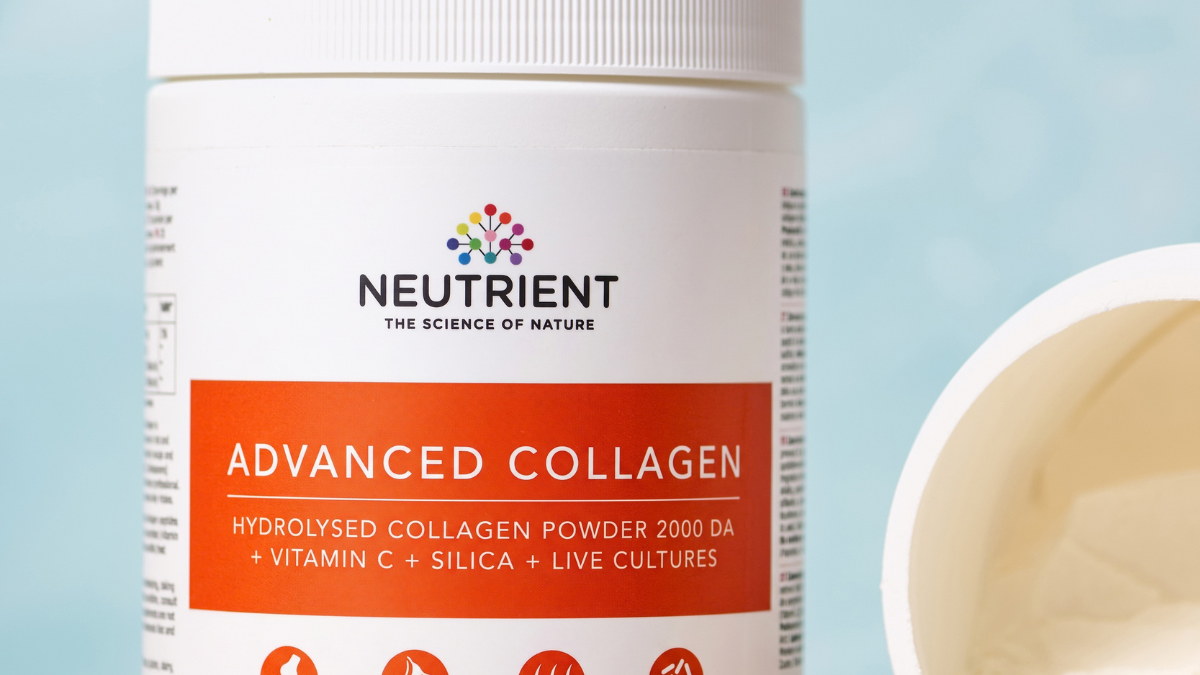
Neutrient Advanced Collagen was designed with all of this in mind. This guide explains the science, the evidence, and exactly why every formulation decision was made.

What is collagen?
Collagen is a structural protein made from long chains of amino acids, coiled into a distinctive triple helix. It's this triple helix structure that gives collagen its extraordinary tensile strength. Researchers have identified 28 distinct collagen types, each tailored to the specific demands of the tissue it supports.¹˒ ⁴
Collagen appears throughout the body wherever structural support, flexibility or strength is needed. Scientists have identified 28 distinct types of collagen. For supplementation purposes, Types I to V are most relevant, with Type I being by far the most important:
Since over 90% of collagen in the human body is Type I, supplementing with bovine collagen — one of the richest sources of Type I collagen, directly addresses the most prevalent and impactful form of collagen depletion.⁴
How collagen declines with age
From your late twenties, fibroblast cells (the cells that make collagen) become less active, while the enzymes that break down existing collagen continue at the same rate. The net result: a steady loss of collagen across all tissues.²⁵,²⁶
In skin, this means reduced elasticity, increased water loss, and the appearance of fine lines. In joints, declining cartilage collagen leads to stiffness and discomfort. In bone, reduced collagen undermines the protein matrix that anchors calcium.
The hormonal changes of the menopause accelerate collagen loss significantly. Research shows that collagen in the skin falls by around 30% in the first five years after menopause, and continues to decline at approximately 2% per year for the following two decades.³,⁴⁴
Oestrogen plays a central role: it activates fibroblasts, promotes collagen gene expression, and slows the enzymes that degrade collagen. As oestrogen falls at menopause, each of these protective mechanisms weakens.⁴³,⁴⁴

Food sources of collagen
Unlike most nutrients, collagen is found almost exclusively in animal-derived foods, specifically in connective tissue, skin, cartilage and bones. Plant foods contain no collagen, though some provide the vitamin C and amino acids needed to support your body's own collagen production.
The richest dietary source is home-made bone broth, produced by simmering animal bones for many hours, which extracts collagen from the bone matrix into the liquid. However, the collagen content varies enormously depending on the type of bones used, cooking time and temperature, making bone broth an unreliable source of therapeutic amounts.
| Food source | Approximate collagen (per 100g) | Notes |
|---|---|
| Home-made bone broth (240ml) | ~2.5-5g | Highly variable depending on bones used and cooking time |
| Pork skin | ~3-5g | One of the richest food sources; used in traditional gelatine |
| Beef (raw) | ~2-3g | Rich in Types I and III; higher in connective tissue cuts |
| Chicken skin/cartilage | ~1-4g | Particularly rich in Type II collagen around cartilage |
| Fish (skin-on, cooked) | ~0.5-2g | Marine source of Type I; higher in oily fish |
| Egg whites | ~0.5g | Contains proline, a key precursor amino acid for collagen |
| Red and yellow peppers | High vitamin C | Essential for collagen synthesis - not a direct source |
| Citrus fruits | High vitamin C | Supports collagen production via vitamin C co-factor activity |
| Plant foods | None | Some provide precursor amino acids; no collagen directly |
What is collagen good for?
Collagen research has expanded well beyond skin, with clinical evidence now spanning joints, bones, muscle, gut health and weight management.


Why are hydrolysed collagen peptides different?
Not all collagen supplements work equally; the difference comes down to molecular weight. Molecular weight determines how much collagen is actually absorbed by the body. CollaSel PRO in Neutrient's Advanced Collagen is engineered to 2,000 Daltons.
Collagen in its natural state is an extraordinarily large and complex molecule. In this native form, collagen molecules are far too large to pass through the intestinal wall. When you eat collagen from food, it has to be progressively broken down during digestion, from long polypeptides into tripeptides, dipeptides and single amino acids.¹
With hydrolysed collagen peptides, this breakdown has already been carried out in advance under controlled conditions. The result is collagen fragments of a defined, small molecular size, ready for rapid absorption.
Products formulated to 2,000 Daltons or below contain those key tripeptides, dipeptides and single amino acids that are absorbed intact without further digestion, entering the bloodstream quickly and travelling to tissues where collagen turnover is active.³⁵
What makes a high-quality collagen powder
Three things matter:
• The source and purity of the collage
• The molecular weight of the peptides,
• The supporting nutrients included to activate collagen's use in the body.
Sourcing, particle size and the absence of unnecessary additives all directly affect how much benefit you get from each serving.
Six things worth knowing about collagen


What makes Neutrient Advanced Collagen different?
Neutrient Advanced Collagen is built on five distinct pillars: a patented, clinically studied collagen; precisely engineered molecular weight; vitamin C as a biochemical co-factor; patented, highly bioavailable silicon; and heat-stable microbiome spores.
CollaSel PRO: patented, clinically studied collagen: CollaSel PRO is not a standard bovine collagen ingredient. It is patented and clinically studied, the only collagen in its class with registered, placebo-controlled clinical trials demonstrating both joint and skin health benefits. It is also the only clinically studied collagen peptide to comply with JAKIM, MUI, MUIS and CICOT Halal certification standards.³⁵
The bioactive peptides encrypted within CollaSel PRO are released during intestinal digestion, where they act on skin degradation, joint and cartilage support, blood pressure and insulin regulation. Clinical studies (ClinicalTrials.gov NCT05235997 for skin; NCT05369780 for joints) demonstrate measurable benefits from week one of regular daily intake.³⁵
Registered, double-blind, placebo-controlled clinical trial results for CollaSel PRO
| Outcome | Clinical result vs placebo |
|---|---|
| Skin hydration | +30% improvement at 8 weeks (skin clinical trial NCT05235997) |
| Skin elasticity | +14% improvement vs placebo at week 8 |
| Skin roughness | Reduced by more than 50% vs placebo at week 12 |
| Joint function (WOMAC) | +128% mean improvement in physical function, stiffness and pain at 8 weeks (NCT05369780) |
| Speed of results | Benefits measurable from week one of daily intake at 10g |
Molecular weight: 2,000 Daltons for rapid absorption
Advanced Collagen is formulated to an average molecular weight of 2,000 Daltons, the threshold at which collagen peptides contain the tripeptides, dipeptides and single amino acids that can be absorbed directly without further digestion.³⁵
At 2,000 Daltons, CollaSel PRO peptides are rapidly taken up into the bloodstream and directed to the skin, joints, bones and connective tissue where collagen turnover is happening. CollaSel PRO also provides intestinal mucosa protection, which improves peptide absorption and supports better blood circulation, speeding up the arrival of benefits.
Vitamin C: the collagen co-factor
Vitamin C is not simply a complementary addition, it is biochemically required for collagen synthesis. It acts as an electron donor for two critical enzymes, prolyl hydroxylase and lysyl hydroxylase, which stabilise and cross-link collagen molecules. Without vitamin C, these enzymes cannot function and collagen production is impaired regardless of how much collagen peptide you consume.³⁷,³⁸,³⁹Vitamin C also protects skin cells from the oxidative stress caused by UV radiation, sugar, smoking and environmental pollutants, all of which damage existing collagen.⁴⁰,⁴¹,⁴²Advanced Collagen provides 60mg of vitamin C per serving as magnesium ascorbate , a buffered, non-acidic form making it significantly gentler than plain ascorbic acid while delivering full vitamin C activity. The 60mg dose meets 75% of the adult daily NRV, and ensures that the enzymatic machinery needed to synthesise new collagen is properly supported with every dose.
Mesoporosil®: patented, highly bioavailable silicon
Mesoporosil® is a patented ingredient developed by EYTELIA — the first highly bioavailable solid silicon available for supplementation. Silicon is a trace mineral with biological roles studied in relation to connective tissue, cartilage, bones, skin, teeth and blood vessels.³⁷The challenge with silicon supplementation has always been bioavailability. Previous solid silicon sources, including marine silica and stabilised silicic acid, achieve only 5–32% intestinal absorption in laboratory models. Mesoporosil® is produced via a patented sol-gel mesoporous process (Patent WO 2017/182245). Laboratory dissolution studies show that 96.7% of the dissolved silicon released from a Mesoporosil® tablet is in the bioavailable monomeric Si(OH)₄ form. It is important to note that this figure is from in vitro laboratory models, not human clinical trials.³⁷Each serving of Advanced Collagen provides 50mg of Mesoporosil® preblend (as E551 mesoporous silica), containing 15mg of Mesoporosil SiO₂. Based on the silicon content and laboratory absorption data, a minimum of 4mg of silicon is assimilated per serving. Mesoporosil® is tasteless, odourless and colourless.³⁷Mesoporosil® compared to other silicium sources. Absorption figures are from in vitro laboratory dissolution studies, not human clinical trials.
Microbiome spores: gut-skin support
Advanced Collagen contains 300 million heat-stable probiotic spores per serving: Bacillus coagulans and Bacillus subtilis. Unlike standard probiotics that can be destroyed by stomach acid or heat, these spore-forming bacteria survive the journey through the digestive tract intact.In the gut, they support microbiome diversity, gut barrier integrity and protein absorption, all of which contribute to better skin health through the gut-skin axis.
No additives, sweeteners or flavourings
Advanced Collagen contains no added sugar, artificial sweeteners, flavourings, colours or unnecessary excipients. It has a neutral flavour and dissolves readily in hot or cold drinks, smoothies, soups or broths without altering their taste.This clean formulation makes it compatible with virtually any dietary approach, including keto, intermittent fasting, dairy-free and gluten-free regimens.
| Ingredient | Amount per serving | Role |
|---|---|---|
| CollaSel PRO bovine hydrolysed collagen peptides (patented) | 10g | Superior-grade Type I and III collagen peptides at 2000 Dalton molecular weight. Rapidly absorbed, rich in hydroxyproline for skin, joints, bones and connective tissue. |
| Vitamin C (as magnesium ascorbate) | 60mg (75% NRV) | Essential co-factor for collagen synthesis enzymes. Buffered, gut-gentle non-acidic mineral ascorbate. Protects skin cells from oxidative stress. 75% of adult daily NRV per serving. |
| Bacillus coagulans (microbiome spores) | 150 million spores | Heat-stable probiotic spore. Survives digestion. Supports gut regularity, gut barrier integrity and protein absorption. |
| Bacillus subtilis (microbiome spores) | 150 million spores | Heat-stable spore-forming bacteria. Supports gut microbiome diversity and immune function within the gut. |

Who is Advanced Collagen for?
Neutrient Advanced Collagen has been designed for the full range of people for whom collagen matters:
• Those focused on skin health, seeking to support hydration, elasticity, texture and a reduction in fine lines and visible signs of ageing
• Peri-menopausal and post-menopausal women, for whom accelerated collagen loss makes targeted supplementation particularly relevant
• Individuals with joint discomfort or active lifestyles, where cartilage support and reduced activity-related joint pain are priorities
• Older adults focused on maintaining bone density, muscle strength and overall mobility
• Those following keto or intermittent fasting plans, who need a clean, high-quality protein source that supports appetite control without disrupting their dietary strategy
• Gym-goers, athletes and fitness enthusiasts seeking a dairy-free alternative to whey protein that also supports connective tissue repair
• Anyone with digestive sensitivity who benefits from a well-tolerated protein powder that simultaneously supports gut microbiome health
• Those seeking a genuinely clean collagen: no additives, no sweeteners, no flavourings, compatible with any diet

How to take Advanced Collagen
The recommended daily serving is 10g (approximately 2 tablespoons), which can be taken at any time depending on your goals and routine.
 Morning

Add to coffee, tea or a breakfast smoothie to start the day with a protein boost
 Pre-workout

Mix into a pre-exercise drink to support connective tissue and provide amino acids before training
 Afternoon

Stir into an afternoon drink to help manage the energy dip and avoid snacking
 Evening

Add to a warm drink before bed to support the body's overnight repair processes
 Anytime

Dissolves in water, juice, soup or broth. Compatible with hot and cold drinks. Neutral flavour

Is collagen safe?
Hydrolysed bovine collagen peptides have an excellent safety profile and are well tolerated at the 10g daily serving, with no significant adverse effects reported in clinical trials. As a natural protein source, they are suitable for long-term daily use.
Clinical studies involving hydrolysed collagen peptides typically use daily doses of 5 to 10g for one to three months, with measurable improvements in skin and joint outcomes reported consistently across this dosing range.
Advanced Collagen does not contain dairy, gluten, soy or artificial additives. Those with known allergies to beef or bovine products should consult a healthcare professional before use. As the product contains probiotic spores, individuals with severely compromised immune function should seek medical advice before starting supplementation.
Disclaimer
Food supplements are not a substitute for a varied diet and healthy lifestyle. Always consult a medical professional before starting a new supplement routine if you are pregnant, breastfeeding, trying to conceive, taking medication or managing a medical condition.
References
1. Aigner T, Gelse K, Poschl E. Collagens: structure, function, and biosynthesis. Adv Drug Deliv Rev. 2003;55:1531–1546.
2. Bertaud A, Godeau G, Senni K. Magnesium and connective tissue. Magnes Res. 2003;16(1):70–74.
3. Raine-Fenning N, Brincat M, Muscat-Baron Y. Skin ageing and menopause. Am J Clin Dermatol. 2003;4(6):371–378.
4. Lodish H et al. Molecular Cell Biology. 4th ed. W.H. Freeman; 2000. Section 22.3.
5. Cao J et al. Probiotic characteristics of Bacillus coagulans. J Funct Foods. 2020;64:103643.
6. Cash A et al. Probiotic Bacillus coagulans GBI-30, 6086 improves protein absorption. Probiotics Antimicrob Proteins. 2018;10(4):611–615.
7. Rial SA et al. Gut microbiota and metabolic health. Nutrients. 2016;8(5):281.
8. Chang et al. Bacillus coagulans (PROBACI) in constipation-dominant functional bowel disorders. Medicine. 2020;99:19.
9. Cuentas AM et al. The effect of Bacillus subtilis DE111 on daily bowel movement. J Prob Health. 2017;5:189.
10. Jusuf NK et al. The effect of oral probiotic on interleukin-10 serum levels of acne vulgaris. Open Access Maced J Med Sci. 2019;7(19):3249–3252.
11. Kodali VP, Sen R. Antioxidant activities of an exopolysaccharide from a probiotic bacterium. Biotechnol J. 2008.
12. Porubsky CF et al. The Role of Probiotics in Acne and Rosacea. InTechOpen. 2018.
13. Praet S et al. Oral supplementation of specific collagen peptides in Achilles tendinopathy patients. Nutrients. 2019;11(1):76.
14. Dressler P et al. Improvement of functional ankle properties with specific collagen peptides. J Sports Sci Med. 2018;17(2):298–304.
15. Responte DJ, Natoli RM, Athanasiou KA. Collagens of articular cartilage. Crit Rev Biomed Eng. 2007;35(5):363–411.
16. Atherton PJ, Smith K. Muscle protein synthesis in response to nutrition and exercise. J Physiol. 2012;590(5):1049–57.
17. Campbell B et al. ISSN position stand: protein and exercise. J Int Soc Sports Nutr. 2007;4:8.
18. Baumstark M et al. Collagen peptide supplementation combined with resistance training improves body composition in elderly sarcopenic men. Br J Nutr. 2015;114(8):1237–1245.
19. Zdzieblik D et al. Improvement of activity-related knee joint discomfort following collagen peptides. Appl Physiol Nutr Metab. 2017;42(6):588–595.
20. Leidy HJ et al. Higher protein intake and eating frequency on appetite control. Obesity. 2010;18(9):1725–1732.
21. Westerterp-Plantenga MS et al. Dietary protein, weight loss, and weight maintenance. Annu Rev Nutr. 2009;29:21–41.
22. Leidy HJ et al. Benefits of a higher-protein breakfast on appetite and hormonal signals. Am J Clin Nutr. 2013;97(4):677–688.
23. Campos PM et al. Oral supplementation of hydrolyzed collagen and vitamins improves skin elasticity. Clin Pharmacol Biopharm. 2015;4(3):1–6.
24. Asserin J et al. The effect of oral collagen peptide supplementation on skin moisture. J Cosmet Dermatol. 2015;14(4):291–301.
25. Kohl E et al. Skin ageing. J Eur Acad Dermatol Venereol. 2011;25:873–884.
26. Batisse D et al. Influence of age on skin wrinkling capacities. Skin Res Technol. 2002;8:148–154.
27. Zague V et al. Collagen hydrolysate intake increases skin collagen expression. J Med Food. 2011;14:618–624.
28. Matsuda N et al. Effects of collagen peptide ingestion on collagen fibrils in the dermis. J Nutr Sci Vitaminol. 2006;52:211–215.
29. Shigemura Y et al. Effect of prolyl-hydroxyproline on fibroblast growth from mouse skin. J Agric Food Chem. 2009;57:444–449.
32. Proksch E et al. Oral intake of specific bioactive collagen peptides reduces skin wrinkles. Skin Pharmacol Physiol. 2014;27:113–119.
33. Proksch E et al. Oral supplementation of specific collagen peptides benefits human skin physiology. Skin Pharmacol Physiol. 2014;27:47–55.
34. Ohara H et al. Improvement of moisture content of stratum corneum following collagen hydrolysate ingestion. Food Sci Technol Res. 2009;56:137–145.
35. Ichikawa S et al. Hydroxyproline-containing dipeptides and tripeptides quantified at high concentration in human blood after oral collagen hydrolysate. Int J Food Sci Nutr. 2010;61:52–60.
36. Inoue N, Sugihara F, Wang X. Ingestion of bioactive collagen hydrolysates enhances facial skin moisture and elasticity. J Sci Food Agric. 2016;96(12):4077–4081.
37. Telang PS. Vitamin C in dermatology. Indian Dermatol Online J. 2013;4(2):143–146.
38. Princeton Consumer Research Ltd. A double-blind study on vitamin C dietary supplement and ageing skin. 2014.
38A. EYTELIA. Mesoporosil® technical dossier and dissolution kinetics data. Patent WO 2017/182245. Mesoporosil Summary Evidence Document provided by EYTELIA, 2024.
39. Pullar JM, Carr AC, Vissers MCM. The roles of vitamin C in skin health. Nutrients. 2017;9(8):866.
40. Knuutinen A et al. Smoking affects collagen synthesis in human skin. Br J Dermatol. 2002;146(4):588–594.
41. Danby FW. Nutrition and aging skin: sugar and glycation. Clin Dermatol. 2010;28(4):409–411.
42. Bosch R et al. Mechanisms of photoaging and photoprotective strategies. Antioxidants. 2015;4(2):248–268.
43. Calleja-Agius J, Brincat M. The effect of menopause on skin and connective tissues. Gynecol Endocrinol. 2012;28(4):273–277.
44. Brincat MP et al. Skin aging and menopause: implications for treatment. Am J Clin Dermatol. 2003;4(6):371–378.
45. Campos PM et al. Hydrolyzed collagen and vitamins improve skin elasticity and dermis echogenicity. Clin Pharmacol Biopharm. 2015;4(3):1–6.
46. Campos PM et al. (as 45, confirmatory citation). Clin Pharmacol Biopharm. 2015;4(3):1–6.